That sharp, radiating pain of sciatica can feel completely overwhelming. But lasting, natural relief is a lot closer than you might think.
At Virginia Joint & Spine Center, we work with active adults right here in Great Falls, VA, to find freedom from pain without turning to surgery or medication. As your local sciatica chiropractor, we understand that this pain isn't a disease on its own. It's a symptom—a loud signal that your sciatic nerve is being compressed. Grasping this is the first real step toward finding effective, natural relief that actually lasts. We are dedicated to helping our community in Great Falls find the root cause and get back to living pain-free.
Your Path to Understanding and Overcoming Sciatica
That shocking, shooting pain that zips from your lower back, through your hip, and down into your leg is the classic calling card of sciatica. It has a way of turning simple things like sitting at your desk, standing up, or going for a walk into major ordeals.
And here’s the thing: while all the discomfort screams from your leg, the root of the problem is almost always in your lower back. That's where the sciatic nerve begins. As your trusted chiropractor in Great Falls, we see this every day.
It's the longest and thickest nerve in your entire body, so when it gets pinched or irritated by something like a herniated disc, spinal stenosis, or even a tight muscle, it sends out those unmistakable pain signals. For so many of our neighbors in Great Falls and across Northern Virginia, this can bring work, fitness routines, and daily life to a grinding halt.
What Causes Sciatic Nerve Pain
To find a solution that sticks, you have to get to the root cause. Sciatica is just the symptom; the real work for a back pain chiropractor is figuring out why it's happening. Here are some of the most common culprits we see at our Great Falls clinic:
- Herniated or Bulging Discs: This is the big one. The soft, gel-like center of a spinal disc pushes out and puts direct pressure on a nerve root. This is a primary reason patients seek a sciatica chiropractor near them.
- Spinal Stenosis: Think of this as a narrowing of the channel your spinal cord runs through, which can crowd and compress the nerves.
- Piriformis Syndrome: Sometimes, it’s not the spine at all. A deep buttock muscle called the piriformis can spasm and clamp down on the sciatic nerve as it passes by.
- Sacroiliac (SI) Joint Dysfunction: Irritation in the SI joint, where your spine meets your pelvis, can create pain that feels exactly like sciatica. You can explore more about how a chiropractor helps with sacroiliac joint pain in our detailed guide.
Sciatica is more than just a local issue; it's a global one. The demand for effective, non-surgical solutions is exploding, with the sciatica treatment market projected to more than double from $5 billion in 2024 to over $12.6 billion by 2033. This massive surge reflects a major shift away from opioids and toward natural, effective care like what we provide at Virginia Joint & Spine Center. It's no surprise that North America, which held nearly half the market share in 2023, is leading the charge. You can dig into more insights on this trend over at marketdataforecast.com.
The good news in all of this? The vast majority of sciatica cases can be resolved without ever needing surgery or relying on medication. This guide will walk you through proven, natural strategies—from at-home exercises to the advanced clinical treatments we offer in Great Falls—that get to the source of the problem, so you can get back to the active life you love.
Effective At-Home Strategies for Sciatica Relief
Taking control of your sciatica pain often starts right at home. While getting professional chiropractic care is crucial for sorting out the root cause, there are some powerful strategies you can use right now to get meaningful, immediate relief.
The goal here isn't to push through the pain. It’s about creating a healing environment for your body by calming down the inflammation, easing muscle tension, and taking direct pressure off that irritated sciatic nerve. Gentle, consistent effort is what builds resilience against future flare-ups.
Gentle Movements to Ease Nerve Pressure
When you're in the middle of a sciatica flare-up, the last thing you probably want to do is move. We get it. But counterintuitively, specific, gentle movements are one of the most effective tools in your arsenal. The key is to gently mobilize the muscles and structures surrounding the sciatic nerve, not force a deep, painful stretch.
Always remember to move slowly, breathe through the movement, and stop immediately if you feel any sharp or worsening pain.
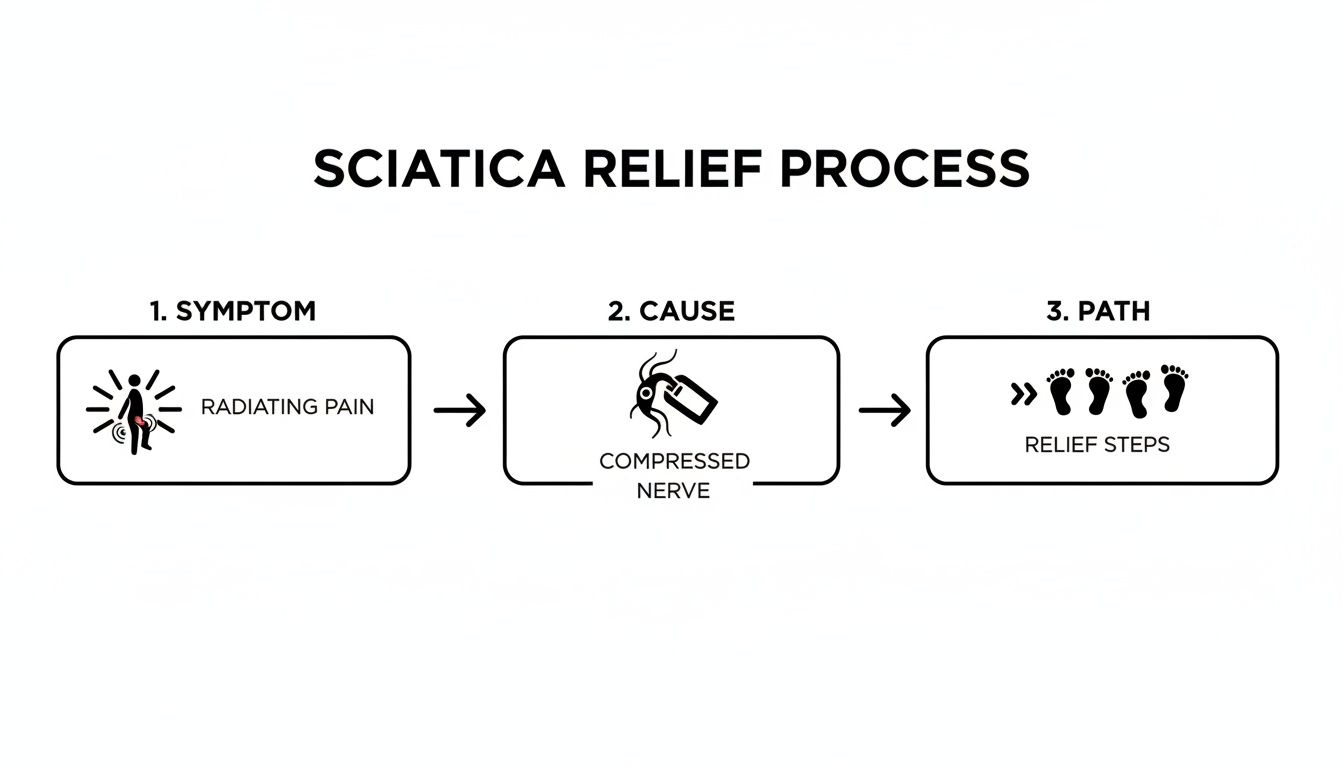
This chart really simplifies the process. It shows how the radiating pain you feel is just a symptom. True relief comes from addressing the root cause—the compressed nerve—which is exactly what our chiropractic care aims to do.
Here are some of the most effective stretches we recommend to our patients in Great Falls for at-home care.
Effective At-Home Sciatica Stretches
| Stretch | Primary Target | How-To and Frequency |
|---|---|---|
| Knee-to-Chest Pull | Lower back and glutes | Lie on your back, knees bent. Gently pull one knee to your chest, holding for 20-30 seconds. Repeat 2-3 times per side. |
| Piriformis Stretch | Piriformis muscle (deep in the buttock) | Lie on your back, cross the ankle of the painful leg over the opposite knee. Gently pull the supporting thigh toward you. Hold 20-30 seconds. |
| Glute Bridge | Glutes and lower back stabilizers | Lie on your back, knees bent, feet flat. Slowly lift your hips to form a straight line from shoulders to knees. Hold for 5-10 seconds, lower slowly. Repeat 8-10 times. |
Adding these simple movements into your daily routine can make a world of difference by creating space around the nerve and relaxing the muscles that might be clamping down on it.
The Power of Heat and Cold Therapy
One of the oldest tricks in the book is still one of the best: alternating heat and cold. It’s a simple but incredibly effective strategy because heat and cold work on two different levels to calm down an angry sciatic nerve.
Think of it this way:
- Cold therapy is your first responder. During the first 48-72 hours of a bad flare-up, wrap an ice pack in a towel and apply it for 15-20 minutes at a time. This helps constrict blood vessels, which reduces inflammation and provides a welcome numbing effect on that sharp pain.
- Heat therapy comes in for cleanup. After that initial inflammatory phase, a heating pad or a warm bath for 15-20 minutes helps relax tight, spasming muscles. The warmth increases blood flow, bringing oxygen and nutrients to the area to accelerate healing.
Everyday Adjustments for Posture and Ergonomics
How you sit at your desk, stand in line at the store, or sleep at night has a massive impact on your spine and, by extension, your sciatic nerve. Making small, mindful adjustments throughout your day can stop the constant aggravation that turns a minor issue into chronic pain.
Improving these daily habits is a cornerstone of lasting relief. When you pair better ergonomics with targeted chiropractic care and exercises, you build a strong foundation for recovery—something we focus on heavily in our physical rehabilitation treatment programs at our Great Falls clinic.
Simple Tweaks to Your Daily Posture
- When Sitting: Try to keep your feet flat on the floor with your knees at roughly a 90-degree angle. A small pillow or rolled-up towel placed behind your lower back can be a game-changer for maintaining your natural spinal curve. And whatever you do, avoid sitting like a statue—get up and move around for a minute or two every 30 minutes.
- When Standing: Distribute your weight evenly across both feet. Think "shoulders back, head level." If you have a job that requires standing for long periods, propping one foot up on a low stool can take a surprising amount of pressure off your lower back. Just be sure to switch feet every so often.
- While Sleeping: The best positions are either on your back with a pillow tucked under your knees or on your side with a pillow between your knees. Both of these positions help keep your spine in a neutral, happy alignment all night long.
These at-home strategies are your first line of defense. By incorporating gentle movement, smart use of hot and cold, and mindful posture, you can find significant relief and start building a stronger, more resilient back.
Lifestyle Adjustments That Support Spinal Health
True, lasting relief from sciatica goes way beyond a few stretches and exercises. It’s about building a lifestyle that supports your spine every single day. Think of it as creating an environment inside your body where it can finally stop just coping with pain and start actively healing.
I can't tell you how many of our patients in Great Falls discover that it's the small, consistent changes in their daily habits that end up making the biggest difference in their back pain.
These adjustments work by chipping away at the chronic, low-level stressors that keep your sciatic nerve angry. From the food on your plate to how you handle a stressful day at work, every choice either calms inflammation or adds fuel to the fire. This bigger-picture view is exactly how we approach natural sciatica relief at Virginia Joint & Spine Center.
The Impact of Diet and Weight on Your Spine
Your spine is your body’s central support beam, and the load it has to carry matters. A lot. Every extra pound you carry puts more mechanical stress on the vertebrae and discs in your lower back—ground zero for most sciatica cases. This constant pressure can speed up wear and tear, making your discs much more likely to bulge or herniate.
What you eat is just as important. An anti-inflammatory diet can be a game-changer for calming down irritated nerves. Foods packed with omega-3 fatty acids, antioxidants, and lean protein help dial down systemic inflammation. Simple swaps, like choosing grilled salmon over fried chicken or grabbing a handful of berries instead of a sugary snack, genuinely support your body's natural healing process.
Breaking Habits That Harm Disc Health
Some habits can actively sabotage all your hard work. Smoking, for instance, is incredibly destructive to your spinal discs. Nicotine is a vasoconstrictor, meaning it squeezes your blood vessels and chokes off blood flow to the discs, starving them of the oxygen and nutrients they need to stay plump and healthy. Over time, this leads to premature disc degeneration and can worsen back and neck pain.
Likewise, a sedentary lifestyle is the enemy of a healthy back. When you sit for long periods, especially hunched over a desk, you're putting sustained pressure on your lumbar discs while the core and back muscles that should be supporting your spine get weaker. Making a real plan to quit smoking and consciously building more movement into your day are two of the most powerful changes you can make.
Mind-Body Practices for Pain Management
The connection between your mind and your physical pain is not just some fuzzy concept—it’s real. When you’re stressed, your body pumps out hormones like cortisol that make your muscles tighten up, including the deep muscles in your back and hips that can clamp down on the sciatic nerve.
This is where mind-body techniques like deep breathing or mindfulness meditation come in. They can actually change how your brain processes pain signals. Just taking a few minutes each day to focus on your breath can dramatically reduce muscle tension and lower your stress levels. It’s not about ignoring the pain; it's about training your nervous system to be less reactive, which can also help with headache and migraine relief.
Sciatica is incredibly common, with some studies showing a prevalence of 9.9%, and it's often linked to other conditions like arthritis. But the power of the mind-body connection is just as real. Research shows that mindfulness meditation can decrease the perception of pain by as much as 35%, and people see results from simple 10-minute guided sessions in just a few days. This mirrors the success we see in Northern Virginia clinics that blend chiropractic care with advanced tools like cool laser therapy, achieving 70-85% success rates with no downtime. You can learn more about the growing market for these effective treatments at meditechinsights.com.
When you integrate these small but powerful lifestyle adjustments, you build a solid foundation for getting rid of sciatica for good. By supporting your body with better nutrition, healthier habits, and a calmer mind, you empower yourself to move beyond just managing symptoms and toward a genuine, lasting recovery.
When to Seek Professional Care for Your Sciatica

While the at-home strategies we've covered are fantastic first-line defenses for managing sciatica, there are definitely times when self-care just isn't enough. It's so important to recognize when your body is signaling that it needs a professional diagnosis and a more targeted treatment plan from a sciatica chiropractor.
If your pain isn't getting better after a couple of weeks of consistent effort, or if it's actively getting worse, that's a clear sign to seek help. Trying to "tough it out" when pain is escalating can often do more harm than good. At Virginia Joint & Spine Center, our priority is giving our neighbors in Great Falls and Northern Virginia a precise diagnosis so we can figure out exactly what’s compressing your sciatic nerve and build a plan that actually works.
Recognizing Red Flag Symptoms
Some symptoms go beyond being a major nuisance—they're red flags that demand immediate medical attention. These signs can point to a more serious underlying condition that needs to be addressed without any delay.
Don't wait to seek care if you experience any of the following:
- Sudden, severe pain in your low back or leg that's paired with numbness or muscle weakness.
- Loss of bladder or bowel control, even if it seems minor. This is a medical emergency.
- Pain that starts right after a traumatic injury, like a car accident or a bad fall. Our auto injury chiropractor can help.
- "Foot drop," which is when you have trouble lifting the front of your foot while trying to walk.
These symptoms warrant an urgent evaluation to rule out significant nerve damage or other serious issues.
Why a Professional Diagnosis Matters
Guesswork has no place in your recovery. That shooting pain down your leg could be from a herniated disc, but it could also be spinal stenosis or even piriformis syndrome. Each of these conditions requires a completely different treatment approach.
At Virginia Joint & Spine Center, we use our diagnostic expertise to pinpoint the exact source of your pain. A thorough examination helps us understand the specific mechanics of your injury, allowing us to move beyond temporary fixes and toward true, lasting relief. This ensures a safer and far more effective recovery.
Getting a clear diagnosis is the single most important step toward getting your life back. If you're a Great Falls resident searching for a "chiropractor near me" because of sciatica that just won't quit, consulting our team is the right move. We'll help you understand what's going on and map out a clear, non-surgical path forward.
Advanced Non-Surgical Treatments for Sciatica
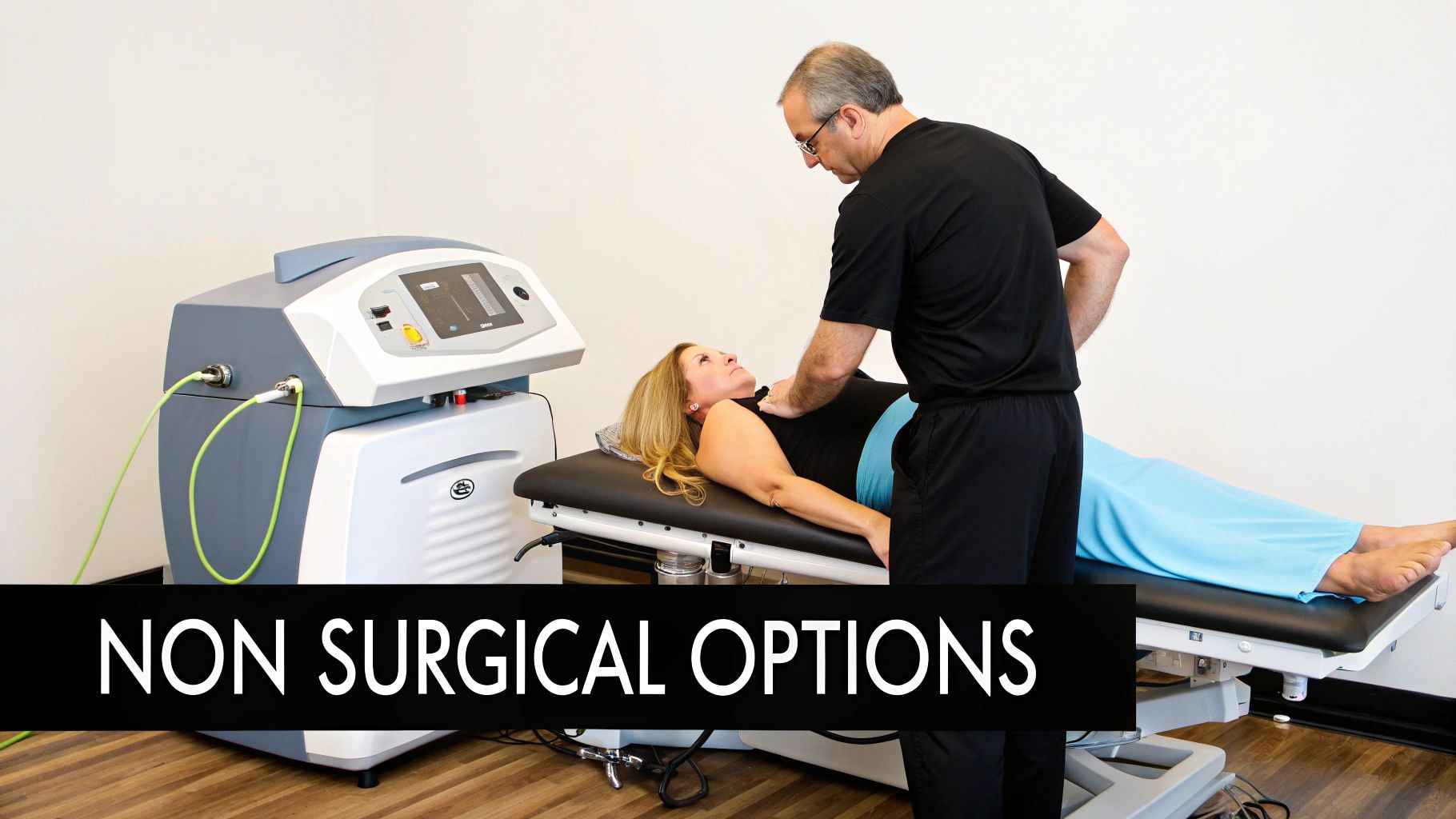
While the at-home strategies we've covered are powerful, sometimes your body needs a stronger, more direct intervention to break the cycle of pain. For those moments, we combine your efforts with advanced clinical care right here in our Great Falls, VA, clinic to get you faster, more meaningful relief.
At Virginia Joint & Spine Center, we don't believe in a one-size-fits-all approach. We offer a range of effective, non-surgical treatments and look at your whole health picture to figure out which combination will get you back on your feet and help you avoid surgery.
Chiropractic Care: The Foundation of Spinal Health
Our clinical approach almost always starts with chiropractic care. This isn't about aggressive "cracking," but rather precise, gentle adjustments designed to restore proper motion to your spinal joints and improve spinal alignment. When vertebrae get stuck or misaligned, they can put direct pressure on the nerve roots feeding into the sciatic nerve, triggering that all-too-familiar inflammation and pain.
By correcting these misalignments, we can physically take the pressure off the nerve. For many of our patients in Great Falls, this provides immediate relief and creates the right environment for long-term healing to begin. It’s the cornerstone of a solid recovery plan for back pain, neck pain, and sciatica.
Spinal Decompression: Creating Space for Discs to Heal
If your sciatica stems from a herniated or bulging disc, non-surgical spinal decompression can be a true game-changer. This gentle, FDA-cleared treatment uses a specialized table that carefully stretches the spine. This creates a negative pressure—almost like a vacuum—inside the damaged disc.
That vacuum effect helps pull the bulging material back into the disc and away from the pinched nerve. It also floods the area with oxygen, water, and nutrients that are critical for healing. Most patients find the treatment incredibly relaxing and report a significant drop in their pain levels.
We’ve seen such incredible results with this therapy that we offer a special $79 spinal decompression package for new patients. It includes a detailed exam and a personalized plan to determine if you’re a good candidate for this effective treatment.
Cool Laser Therapy: Reducing Inflammation at the Cellular Level
Inflammation is a huge part of what makes sciatica so painful. Cool Laser Therapy, also known as Low-Level Laser Therapy (LLLT), uses specific wavelengths of light that penetrate deep into your tissues without any heat.
This light energy gives your cells a boost, stimulating repair, calming inflammation, and even blocking pain signals at the nerve level. It's a painless, non-invasive way to accelerate your body's own healing mechanisms and works incredibly well alongside chiropractic care and decompression.
It’s clear people are looking for these kinds of evidence-based options. The global sciatica market is expected to hit $11.78 billion by 2032, driven by the 83% of patients who want solutions that don't involve drugs. This trend makes sense when you consider that only 31% of sufferers know a herniated disc is the most common culprit. You can learn more about these treatment trends from Fortune Business Insights.
Our Integrated Approach to Sciatica Treatment
Here at Virginia Joint & Spine Center, we believe in using the right tool for the right job. Your treatment plan will likely be a combination of therapies that work together to deliver the best possible outcome.
Here’s a quick look at some of the advanced, non-surgical treatments we offer to help our patients in Great Falls find lasting relief from sciatica.
Non-Surgical Sciatica Treatments at a Glance
| Treatment | How It Helps Sciatica | Ideal For |
|---|---|---|
| Chiropractic Care | Realigns spinal joints to relieve direct nerve pressure and restore proper movement. | Patients with spinal misalignments contributing to nerve irritation. |
| Spinal Decompression | Gently creates negative pressure to retract herniated discs and promote healing. | Sciatica caused by bulging, herniated, or degenerated discs. |
| Cool Laser Therapy | Reduces inflammation and pain at the cellular level to accelerate tissue repair. | Patients with significant inflammation and nerve-related pain. |
| Trigger Point Injections | Targets and releases tight muscle knots (trigger points) that can compress the sciatic nerve. | Sciatica aggravated by muscle spasms, like in Piriformis Syndrome. |
| Enriched Plasma Therapy | Uses your body's own growth factors to stimulate and accelerate natural healing in damaged tissues. | Individuals with chronic soft tissue or disc injuries needing enhanced repair. |
This multi-faceted approach is why people from Great Falls and across Northern Virginia trust us to help them get back to their active lives. By combining these advanced treatments, we can attack your pain from multiple angles, leading to faster, more durable relief—all without the risks and downtime that come with surgery.
Take the First Step Toward a Pain-Free Life in Great Falls
Living with sciatica doesn't have to be your new normal. As we've explored, getting back to the active life you love is entirely possible through a smart blend of consistent at-home care and professional, non-surgical treatment. You don't have to just "put up with" the pain.
We’ve walked through the gentle stretches, supportive lifestyle changes, and advanced therapies that can free you from that relentless nerve pain. But true recovery isn't just about quieting the symptoms—it's about digging in and fixing the root cause of the nerve compression for good.
Your Local Partner in Spinal Health
At Virginia Joint & Spine Center, we're more than just a clinic; we're part of the Great Falls community. We get how frustrating and draining it is when pain from sciatica, a disc injury, or whiplash takes over your life, and our entire team is here to provide the expert, patient-first care you deserve. We believe in working with you to build a personalized plan that actually fits your body, your goals, and your life.
The first step is always the hardest, but it's also the most critical. Taking action and getting a professional diagnosis is the key that unlocks an effective, targeted treatment plan. We're here to make that step as simple and reassuring as possible.
Don't let sciatica dictate another one of your days. It’s time to take control. We proudly serve Great Falls and the surrounding Northern Virginia area with a clear, non-surgical path to getting you back on your feet.
We offer convenient hours, including Saturday wellness appointments, because we know your schedule is packed. For a limited time, new patients can take advantage of our $79 spinal decompression package, which includes a detailed exam and a customized chiropractic plan.
Contact Virginia Joint & Spine Center to book your appointment and start your journey toward a pain-free life.
Answering Your Questions About Natural Sciatica Relief
When you’re dealing with the sharp, radiating pain of sciatica, you’re bound to have questions. It's completely normal. Here are some clear, straightforward answers to the concerns we hear most often from our patients right here in Great Falls, VA.
How Long Until I Feel Relief from Natural Sciatica Treatments?
This is usually the first question people ask, and the honest answer is: it depends. The timeline for relief really hinges on the root cause and severity of your sciatica. Many people start to feel a significant difference within a few weeks of consistent at-home care, like gentle stretching and being more mindful of their posture.
However, getting professional help from a chiropractor can really speed things up. Therapies like chiropractic adjustments and non-surgical spinal decompression often bring noticeable relief after just a handful of sessions. At Virginia Joint & Spine Center, we build a personalized plan to get you feeling better as quickly—and safely—as we can.
Can a Chiropractic Adjustment Actually Make My Sciatica Worse?
It’s a fair question and a common fear. When performed by a qualified and experienced professional, chiropractic care is an incredibly safe and effective way to treat most causes of sciatica. The key is that we always start with a thorough examination to make absolutely sure our care is the right approach for you.
Our chiropractors in Great Falls use precise, gentle adjustments aimed directly at relieving nerve pressure and correcting the spinal misalignments that are causing your pain in the first place. The entire goal is to calm your sciatica symptoms, not aggravate them.
Should I Be Walking if I Have Sciatica Pain?
For most people, yes—gentle walking is fantastic for sciatica. It gets the blood flowing to the irritated nerve, helps dial down inflammation, and strengthens the core and back muscles that support your spine. Best of all, it does all this without high-impact stress.
The trick is to start slow. Think short, frequent walks on flat surfaces and, most importantly, listen to your body. You should never push through sharp or increasing pain. If walking consistently makes your symptoms flare up, that’s a clear signal that it's time for a professional evaluation to figure out exactly what’s going on.
Did you know that between 10-40% of people worldwide will grapple with sciatica at some point? With an aging global population, natural remedies are becoming a game-changer for non-invasive relief. Interestingly, studies show that in the U.S., up to 90% of cases resolve naturally within 12 weeks with the right care. Learn more about the rise of natural sciatica remedies and their impact on Meditech Insights.
At Virginia Joint & Spine Center, our team is dedicated to providing the Great Falls community with effective, non-surgical solutions for sciatica. Take the first step toward lasting relief and discover how our integrated approach can help you get back to the active life you love.
Schedule your consultation today at https://loebigchiropractic.com.


