If you're in Great Falls, VA, struggling with arm numbness, a constant shoulder ache, or a grip that just isn’t what it used to be, you might be dealing with Thoracic Outlet Syndrome (TOS). It's a frustrating condition where nerves or blood vessels in the neck and shoulder get pinched, but the good news is that chiropractic care offers a clear, non-surgical path to relief. Here at Virginia Joint & Spine Center, our experienced chiropractors focus on getting to the root of the mechanical issues causing your pain and restoring function for our patients in Great Falls and the surrounding communities.
Your Guide to Thoracic Outlet Syndrome Pain Relief in Great Falls
Dealing with that strange, unexplained pain, tingling, or weakness that travels from your neck and shoulder down into your hand is both confusing and maddening. You might feel it most when reaching for something on a high shelf, carrying groceries, or even just typing at your desk. These sensations are classic signs of Thoracic Outlet Syndrome, a condition our local chiropractic clinic is highly experienced in treating.
Think of the thoracic outlet as a tight corridor running between your collarbone and top rib. It’s a critical passageway for all the nerves and blood vessels that supply your arm. When that space gets crowded—whether from tight muscles, poor posture from sitting at a desk, or an auto injury—it creates a "traffic jam." This compression is what triggers the symptoms that can seriously disrupt your life.
At Virginia Joint & Spine Center, we specialize in diagnosing and treating the mechanical problems behind TOS for people right here in Great Falls, VA. As a trusted local chiropractor, we understand how much these symptoms can interfere with your work, hobbies, and peace of mind. Our approach is built around not just quieting the pain, but restoring proper function so you can get back to doing what you love.
Who Is Affected by Thoracic Outlet Syndrome?
While TOS can happen to anyone, it often affects certain groups more than others. It's a common problem for active adults and athletes, where nerve or blood vessel compression can lead to pain and numbness that sidelines even the most dedicated individuals. A detailed study on TOS in active people highlights just how disruptive it can be.
Here in Great Falls, our chiropractors often see patients whose TOS is linked to a few common causes:
- Repetitive Job Demands: People who spend long hours at a desk or perform overhead work often develop postural strain that leads to compression.
- Athletic Activities: Sports that rely on repetitive arm movements—like swimming, baseball, or weightlifting—can create muscle imbalances that put pressure on the thoracic outlet.
- Auto Injuries: The jolt from a car accident can cause whiplash or other misalignments in the neck and upper back, which are well-known triggers for TOS. If you're looking for an auto injury chiropractor near you, we can help.
Our goal is simple: provide a clear diagnosis and an effective, non-surgical treatment plan that targets the specific cause of your discomfort. That's how you find real, lasting relief.
Why the Thoracic Outlet Causes Pain
To understand why Thoracic Outlet Syndrome (TOS) can be so frustrating, you have to picture the thoracic outlet itself. It's a tight, critical passageway running from the base of your neck, down between your collarbone and first rib, and into your arm. This isn’t empty space; it’s a crowded tunnel packed with the vital nerves and blood vessels that serve your entire arm and hand.
When everything has enough room, traffic flows smoothly. But if that tunnel narrows, you get a major traffic jam. This compression is the source of the pain, numbness, tingling, and weakness you might be feeling. For our patients here in Great Falls, VA, this "traffic jam" almost always traces back to a few common culprits.
The Three Types of Thoracic Outlet Compression
The specific symptoms you feel depend entirely on what is getting squeezed. This leads to three distinct types of TOS, though it’s not uncommon to have a mix of symptoms. The vast majority of cases—over 90%—are Neurogenic, meaning a nerve is involved.
- Neurogenic (Nerve) TOS: This is what we see most often at our clinic. It happens when the brachial plexus, a delicate web of nerves controlling your shoulder, arm, and hand, gets pinched. This can feel like pins-and-needles, a dull ache in your neck or shoulder, or a weak grip.
- Venous (Vein) TOS: This type occurs when the subclavian vein is compressed, affecting blood flow out of your arm. It can cause sudden swelling, a heavy feeling in the arm, and sometimes a bluish tint in the hand.
- Arterial (Artery) TOS: The rarest and most serious form, Arterial TOS involves the compression of the subclavian artery, reducing blood supply to the arm. Symptoms might include a cold or pale hand and fingers, a weak pulse, and pain that flares up with activity.
Common Causes of Compression in Great Falls
So, what makes the thoracic outlet get so crowded? The root causes are almost always mechanical, tied directly to the bones and muscles in this sensitive area. Time and again, our chiropractors see patients whose TOS was triggered by one of these issues.
Poor posture is a huge contributor, especially the "forward head" posture many of us adopt at a desk. This position forces the scalene muscles in the neck to tighten and pulls the collarbone down against the first rib, shrinking the available space. If you're constantly fighting neck stiffness, you can learn more about what causes chronic neck pain and how to break the cycle.
Repetitive overhead activities can also be a trigger. Think of swimmers, painters, or construction workers. These motions can lead to muscle enlargement in the neck and chest, and those overdeveloped muscles can press on the nerves and vessels.
This concept map helps visualize how all these pieces fit together.
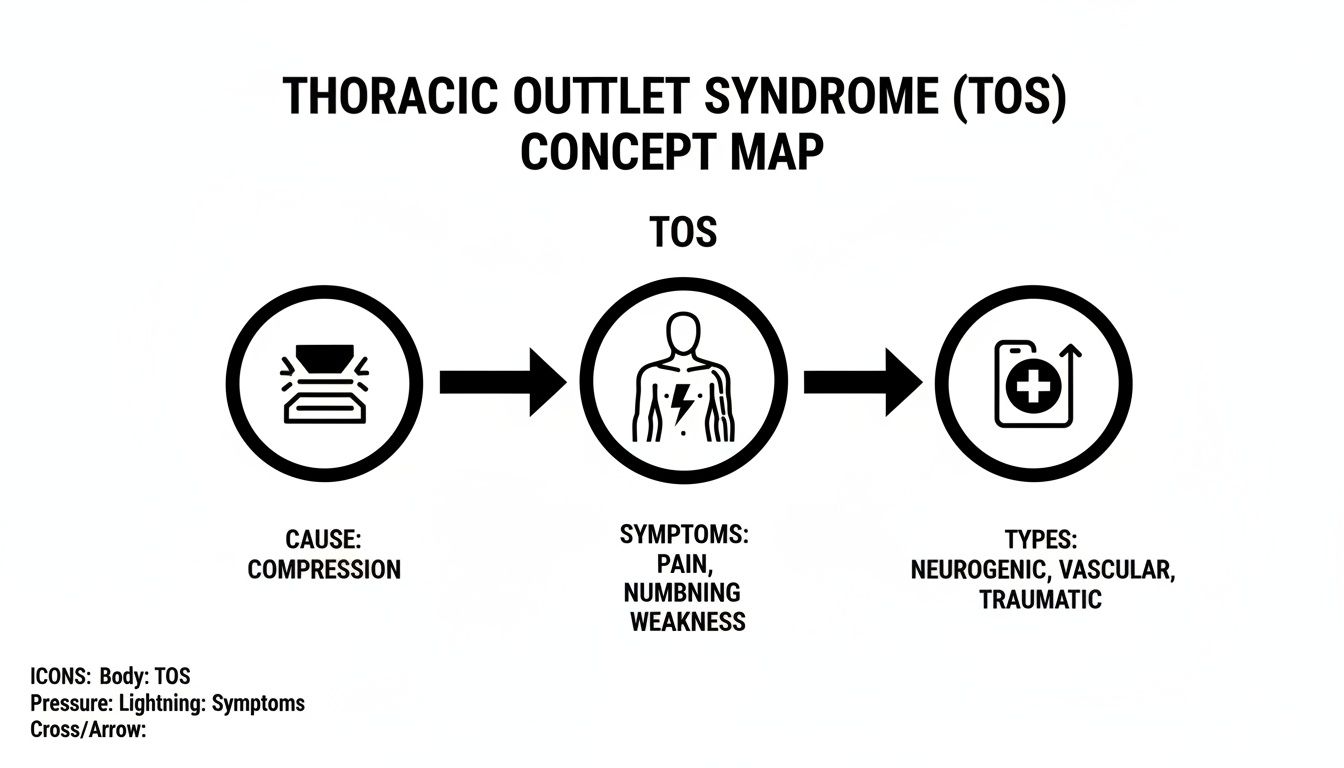
As you can see, pressure from different sources funnels down to create the neurological or vascular symptoms of TOS.
Finally, physical trauma—like a car accident or a bad fall—can cause sudden structural shifts, such as a misaligned first rib or collarbone. This kind of anatomical change can create immediate and lasting compression.
At its core, Thoracic Outlet Syndrome is a space issue. The goal of effective chiropractic care is not just to manage the symptoms, but to restore the space needed for nerves and blood vessels to function without interference.
Understanding these causes is the first crucial step. By figuring out why the compression is happening, we can build a targeted treatment plan to correct the underlying mechanical problem and provide lasting relief from thoracic outlet syndrome.
How Our Chiropractor in Great Falls Pinpoints Thoracic Outlet Syndrome

Finding the true source of your pain is the single most important step toward getting lasting relief. At Virginia Joint & Spine Center, we don’t guess. We use a meticulous diagnostic process to figure out precisely what’s causing your symptoms. For our patients in Great Falls, VA, dealing with frustrating arm numbness or shoulder pain, this process accurately identifies Thoracic Outlet Syndrome (TOS) and rules out other conditions that can mimic it.
This thorough approach means the treatment plan we design for you is targeted, effective, and built on certainty. When you visit our chiropractic clinic, the first thing we do is listen.
Your Comprehensive Health History Discussion
Your story tells us more than you might think. We’ll sit down with you to discuss not just your symptoms, but your entire health picture. This conversation helps us connect the dots between your daily life and the pain you're feeling.
We'll ask about things like:
- Your symptoms: When did they start? What makes them better or worse? Is the tingling in your fingers constant, or does it come and go?
- Your job and hobbies: Do you work at a desk all day, perform overhead tasks, or play sports? These activities often contribute to the muscle imbalances we see in TOS.
- Past injuries: Have you ever been in an auto accident or had a bad fall that impacted your neck or shoulders? An old injury can create subtle structural shifts that lead to compression years later.
This initial discussion gives us critical clues that guide the rest of our examination.
The Hands-On Physical Examination
Once we understand your history, our board-certified chiropractor performs a hands-on physical and neurological exam. This is where we assess your body’s mechanics, checking your posture, muscle tone, and range of motion in your neck and shoulders. We're looking for the specific physical signs that point to compression in the thoracic outlet.
An accurate diagnosis isn't just about naming the problem—it's about understanding the specific structural and muscular imbalances that created it. This detailed understanding allows for a much more precise and effective treatment approach.
We use a series of proven orthopedic tests designed to gently and safely provoke your symptoms in a controlled way. These maneuvers temporarily narrow the thoracic outlet, which helps us confirm if and where compression is happening.
For example, Adson's test is a classic diagnostic tool for TOS. During this simple test, we'll have you turn your head and take a deep breath while we monitor the pulse in your arm. A change in your pulse or a reproduction of your symptoms strongly suggests that the structures in your thoracic outlet are getting squeezed. Other tests, like the Roos test or Wright's test, help us gather more evidence to be absolutely sure.
When Imaging Becomes Necessary
In most cases, a thorough history and a detailed physical exam are all we need to confidently diagnose neurogenic TOS.
However, if we suspect a blood vessel is involved (vascular TOS) or want to rule out other issues like a cervical disc injury, we may refer you for diagnostic imaging. An X-ray can show us if you have an anatomical variation like a cervical rib, while a Doppler ultrasound can assess blood flow. This ensures we have a complete picture before we begin treatment.
Chiropractic Care: A Cornerstone of Non-Surgical TOS Treatment

Once we have a clear diagnosis, our focus shifts to providing targeted, effective relief. Here at Virginia Joint & Spine Center in Great Falls, VA, our approach to treating Thoracic Outlet Syndrome (TOS) is about getting to the root of the mechanical problem, not just masking symptoms. We specialize in non-surgical solutions that restore proper function and create the space your body needs to heal.
For many of our patients in the Great Falls area, finding lasting relief without medications or invasive procedures is exactly what they’re looking for. Our hands-on chiropractic care is designed to do just that by directly addressing the structural and muscular issues causing nerve and blood vessel compression.
Restoring Space With Precise Spinal Adjustments
The heart of our chiropractic approach for TOS involves gentle, precise adjustments aimed at the specific structures crowding the thoracic outlet. This isn't about forceful movements; it's about carefully restoring mobility and creating breathing room where compression is happening.
The first rib and the vertebrae in your lower neck act as the floor and walls of that critical passageway. If they shift out of position—a condition we call a subluxation—it effectively shrinks the tunnel.
Our first goal is to correct these misalignments. By applying a specific, controlled force, we can:
- Improve First Rib Mobility: A "stuck" or elevated first rib is a classic finding in TOS. A targeted adjustment can restore its proper downward movement, immediately taking pressure off the nerves and vessels that pass over it.
- Correct Cervical Spine Alignment: Ensuring the vertebrae in your neck are moving correctly reduces strain on surrounding muscles—especially the scalenes—which are often tight in TOS.
- Enhance Nerve Function: Relieving this structural pressure allows the brachial plexus nerves to send and receive signals without interference, which is key to reducing tingling, numbness, and weakness.
This foundational work sets the stage for a complete recovery by fixing the underlying skeletal component first.
Releasing Muscle Tension With Soft Tissue Therapies
Correcting joint position is only half the battle. The tight, overworked muscles around the thoracic outlet often act as the primary compressors. To tackle this, we integrate advanced soft tissue therapies into your care plan.
One of the most effective techniques we use at our Great Falls clinic is Instrument-Assisted Soft Tissue Mobilization (IASTM). This involves using specially designed stainless steel tools to gently treat areas of scar tissue and fascial restriction within the muscles.
For TOS patients, we focus on key culprits like the scalenes in the side of your neck and the pectoralis minor in your chest. IASTM helps us break down adhesions and release chronic tension contributing to the compression. This provides immediate relief and helps restore healthy muscle tissue, which is crucial for preventing future flare-ups.
By combining precise adjustments with targeted muscle work, we create a powerful two-pronged attack on Thoracic Outlet Syndrome. We restore the proper 'container' (the skeletal framework) and relax the 'contents' (the surrounding muscles) to give your nerves and blood vessels the freedom they need.
The evidence consistently backs up this kind of conservative care. Studies show that about 90% of TOS patients achieve complete symptom relief through conservative therapies like chiropractic manipulation and rehabilitation. You can dig into the findings on how well non-surgical TOS treatments work on ncbi.nlm.nih.gov.
This is why we’re so confident in our approach. Chiropractic care isn't a temporary patch; it's a fundamental solution aimed at correcting the source of your problem for results that last.
An Integrated Approach to Healing and Lasting Recovery
Effective treatment for Thoracic Outlet Syndrome (TOS) isn't about a single magic bullet. It’s about a complete strategy that understands your body is an interconnected system. Here at Virginia Joint & Spine Center, we achieve superior, long-lasting results because we combine multiple proven therapies into a personalized recovery plan.
This integrated approach ensures we’re not just chasing your symptoms, but correcting the root cause of the compression. Chiropractic adjustments are often the first step—they create space and restore proper movement. But real, lasting recovery depends on what comes next: building strength and stability around that newly corrected structure.
Building Resilience with Therapeutic Exercises
Once we’ve improved the alignment of your spine and ribs, the real work of retraining the supporting muscles begins. Without this critical step, the old patterns of tension and weakness that caused your TOS will inevitably return.
Our team designs a therapeutic exercise program specifically for you. These are precise movements aimed at very specific goals:
- Strengthening Scapular Stabilizers: The muscles around your shoulder blades are often weak, contributing to poor posture. We focus on strengthening them to help pull your shoulders back and open up that critical space.
- Stretching Tight Muscles: We'll guide you through targeted stretches for the scalene and pectoral muscles. This helps release the chronic tightness that pulls your head forward and down.
- Improving Postural Awareness: Through these exercises, you’ll develop a better sense of your body's position, making it easier to maintain good posture throughout your day.
Postural correction is a cornerstone of successful TOS management. The right combination of adjustments and targeted rehab exercises can produce incredible results. A case report in the Parker University Journal shows just how well these interventions can restore function. You can learn more about our approach to building strength through our physical rehabilitation treatment.
Accelerating Healing with Advanced Therapies
To speed up recovery, we often incorporate advanced therapies into your treatment plan. One of the most effective tools in our arsenal for TOS is Cool Laser Therapy.
This non-invasive therapy uses specific wavelengths of light to penetrate deep into inflamed tissues. It works at the cellular level to:
- Reduce Inflammation: It calms irritation around the compressed nerves and blood vessels, providing significant pain relief.
- Accelerate Tissue Repair: The light energy stimulates your cells' metabolism, helping damaged muscles and soft tissues heal faster.
By combining precise adjustments, muscle rehabilitation, and advanced therapies like cool laser, we create an environment where your body can truly heal. This integrated plan not only gets you out of pain faster but also gives your body the strength and stability to keep the problem from coming back.
This complete approach ensures we address every factor contributing to your TOS. We’re not interested in temporary relief. We’re here to build a foundation for your long-term health and resilience.
Your Partner in Recovery at Virginia Joint and Spine Center
Deciding to finally do something about your pain is a huge first step, and we want to be your dedicated partner on that journey. We understand that dealing with the constant ache, numbness, and weakness from Thoracic Outlet Syndrome is draining. Our entire clinic here in Great Falls, VA, is built around one goal: making your path to recovery as clear, comfortable, and effective as possible.
From the moment you walk through our doors at 754 Walker Rd, you'll feel the difference. We’ve created a professional, welcoming space where your health is our priority. We know life is hectic, which is why we offer convenient weekday and Saturday hours to fit your schedule. Our job is to remove any barriers standing between you and the expert chiropractic care you need.
Making Your First Visit Simple and Stress-Free
Getting started shouldn't be the hardest part of getting better. To make your first visit smooth, we have online forms you can fill out from home. This means that when you're here, we can focus 100% on you, your story, and what it's going to take to get you feeling well again.
We also believe in total transparency. You'll receive a clear, good-faith estimate so you know exactly what to expect financially. No surprises—just a straightforward plan focused on getting you results. Our team is here to answer any questions you have, making sure you feel confident and in control of your care.
Your recovery is a team effort. We bring the expert diagnosis and advanced, non-surgical treatments; you bring the commitment to your own health. Together, we can achieve real, lasting relief from Thoracic Outlet Syndrome.
Take Control of Your Health Today
You don't have to live with the limits that neck, shoulder, and arm pain are putting on your life. That tingling in your fingers, frustrating weakness in your grip, and nagging ache don't have to be your new normal. An accurate diagnosis followed by a targeted, non-surgical treatment plan from a trusted chiropractor can get to the root cause of your pain and give you your function back.
If you're ready to find a real solution for thoracic outlet syndrome and chiropractic care feels like the right path, we're here to help. Reach out to Virginia Joint & Spine Center today to schedule your comprehensive consultation. Let our team in Great Falls, VA, show you what life without this pain can feel like.
A Few Common Questions We Hear About TOS
When you're dealing with pain, you've got questions. We believe getting clear, straightforward answers is the first step toward feeling confident in your recovery plan. Here are some of the things our patients in Great Falls often ask about Thoracic Outlet Syndrome.
How Long Until I Feel Relief from TOS Symptoms?
This is usually the first thing people want to know. While everyone's healing journey is unique, many of our patients start to feel a real improvement in their symptoms within just a few weeks of starting care. Our first priority is to calm down the most intense symptoms to give you immediate breathing room.
From there, your treatment plan is built to deliver both initial relief and a lasting correction. We constantly check your progress at every visit, ready to adjust your plan to ensure you're healing as quickly and effectively as possible.
Is Chiropractic Treatment for Thoracic Outlet Syndrome Painful?
It’s a completely fair question. The idea of adjustments around a sensitive area can be intimidating. You can relax—our chiropractic adjustments for TOS are incredibly gentle and precise. Most patients report feeling a sense of relief or a release of pressure, not pain.
Some of the hands-on therapy we do to release stubborn, tight muscles might leave you with a bit of temporary soreness, similar to what you'd feel after a deep-tissue massage. But we always prioritize your comfort and communicate with you through every step of the process.
Can Chiropractic Care Prevent My TOS from Returning?
Absolutely. In fact, that's the whole point. We're not just interested in getting you out of pain for a little while; we want to make sure this problem doesn't return. Preventing a recurrence is a core part of our approach to thoracic outlet syndrome and chiropractic care.
Our strategy is to fix the underlying mechanical issues—like a stuck first rib or poor postural habits—that caused the compression in the first place. By restoring proper movement, strengthening key muscles, and giving you the tools to maintain good posture, we get to the root of the problem. This gives your body the resilience it needs to stay healthy long after you've finished your treatment with us.
Is Surgery My Only Option for Thoracic Outlet Syndrome?
For the overwhelming majority of people, the answer is no. Surgery is rarely the first or only answer for TOS. Conservative, non-invasive treatments like the ones we provide right here at our Great Falls chiropractic clinic are incredibly effective for this condition.
You don't just have to take our word for it. Research consistently shows that conservative care works for about 90% of TOS cases. Our entire focus is on finding a way to get you lasting relief without surgical intervention. We are committed to exhausting all proven, safe, and effective therapies that fix the source of the problem, not just mask it.
If you're tired of dealing with frustrating neck, shoulder, or arm pain, our team at Virginia Joint & Spine Center is ready to help you find answers. Take the first step toward a life without pain and schedule your consultation with our Great Falls chiropractor today.


